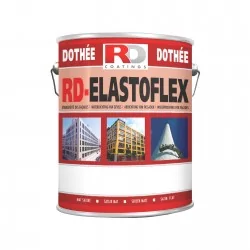



Concrete Carbonation: Understanding the Phenomenon and Preventing It Long-Term with RD-Elastoflex

Concrete carbonation is a natural process that occurs gradually when concrete is exposed to air.

Our RD Academy experts present a clear and structured explanation:

1. Principle of Carbonation
  • Concrete is naturally alkaline (pH ~ 12.5–13) due to calcium hydroxide [Ca(OH)₂] formed during cement hydration.
  • This high alkalinity protects the steel reinforcement by forming a passive, adherent oxide layer.
  • When carbon dioxide (CO₂) from the air penetrates the concrete (through pores and microcracks), it reacts with calcium hydroxide: Ca(OH)₂ + CO₂ → CaCO₃ + H₂O
  • This reaction consumes lime and produces calcium carbonate (CaCO₃), which lowers the pH of the concrete to around 8–9.
      2. Effects on Reinforcement
      • The passive protection of steel disappears once the pH drops below ~9.
      • If moisture and oxygen are also present, corrosion starts.
      • Corrosion leads to:
        • Formation of rust (iron oxides) occupying 2–6 times the volume of the original steel.
        • Cracking of concrete due to internal pressure.
        • Spalling of the concrete cover.
        • Reduction in steel cross-section → decreased mechanical strength and durability.
          3. Factors Influencing Carbonation
          • Permeability of concrete (linked to density and water/cement ratio).
          • Thickness of concrete cover over reinforcement.
          • Environmental conditions: CO₂ concentration, relative humidity (~50–70 % promotes carbonation), temperature.
          • Presence of cracks.
            4. Prevention Measures
            • Use dense concrete (low W/C ratio, proper curing).
            • Provide adequate cover thickness.
            • Use mineral additives (pozzolans, fly ash, etc.) to improve compactness.
            • Protect exposed surfaces (coatings, hydrophobic treatments).

              🎯 How RD-Elastoflex Prevents Carbonation

              RD-Elastoflex is a flagship coating from RD Coatings’ technical range, developed through many years of research and testing.

              Since its launch in 2006, it has been applied on thousands of concrete façades and structures, including bridges.

              “Concrete will always crack somewhere – the question is just where and when!”

              RD-Elastoflex forms an elastic barrier that is waterproof and impermeable to CO₂ while remaining vapour-permeable.

              Key Property

              Function

              Result

              Very low CO₂ permeability

              Blocks CO₂ penetration

              Prevents pH drop → stops carbonation

              Waterproof

              Prevents water and salt migration

              Protects concrete and reinforcement

              Vapour-permeable (breathable film)

              Allows internal moisture to escape

              Prevents blistering, peeling, and mould growth

              Outstanding elasticity
              (> 600 %)

              Bridges microcracks and movement

              Stops water ingress through cracks

              Water-based – solvent-free

              Safe, low-odour application

              Ideal for interior and exterior works

              UV- and weather-resistant

              Excellent long-term stability

              Maintains appearance and performance

              ⚙️ Key Technical Performances

              • Complies with EN 1504-2 (Carbonation protection – principles 1.3 & 2.2)
              • CO₂ diffusion coefficient Sd > 50 m (EN 1062-6) → excellent carbonation barrier
              • Crack-bridging ability (EN 1062-7):
                • Cyclic crack movement 0.3 mm ± 0.1 mm
                • Crack widening > 0.5 mm – Class A3
              • Capillary absorption S ≤ 0.008 [kg/(m²·h⁰˙⁵)] (EN 1062-3)
              • Water vapour permeability Sd < 4 m → breathable film (DIN 53 122-1)
              • Frost/thaw and thermal shock resistance (EN 13687-1 & -2): no visible degradation

              🧩 Typical System for Carbonated or Cracked Concrete

              1. Surface preparation: cleaning and repair of spalled areas (use EN 1504-3 mortar if required)
              2. Primer (if porous): RD-Unifix
              3. Two coats of RD-Elastoflex (approx. 0.4–0.6 kg/m² per coat)

              RD-Elastoflex is available in many colours and can be custom-tinted on request.

              💡 Summary

              RD-Elastoflex is a breathable, elastic protective membrane designed to prevent concrete carbonation and extend the lifespan of structures.

              Thanks to its CO₂ barrier, water resistance, exceptional elasticity (> 600 %) and EN 1504-2 compliance, it offers a complete, durable and environmentally friendly solution for concrete protection and renovation.